
What Are Top, Heart and Base Notes in a Perfume?
Have you ever sprayed a fragrance you loved in the store, only to find it smelled almost nothing like that an hour later on your skin? You're not imagining it, and your nose isn't broken. What you experienced is a perfume doing exactly what it was designed to do: unfold in stages. That first burst you fell for was the perfume top note, and it was never meant to stick around. Perfume isn't a single, flat smell. It's a small piece of choreography that plays out over hours, moving from bright and fleeting to warm and lasting. Understanding how that journey works from the opening top note down to the deep base is honestly the single most useful thing you can learn as a fragrance buyer. It changes how you test, how you shop, and how often you end up disappointed. So let's break down what are top, heart and base notes in a perfume, how they behave on skin, and how to use that knowledge the next time you're choosing a scent.
What Is a Perfume Top Note?
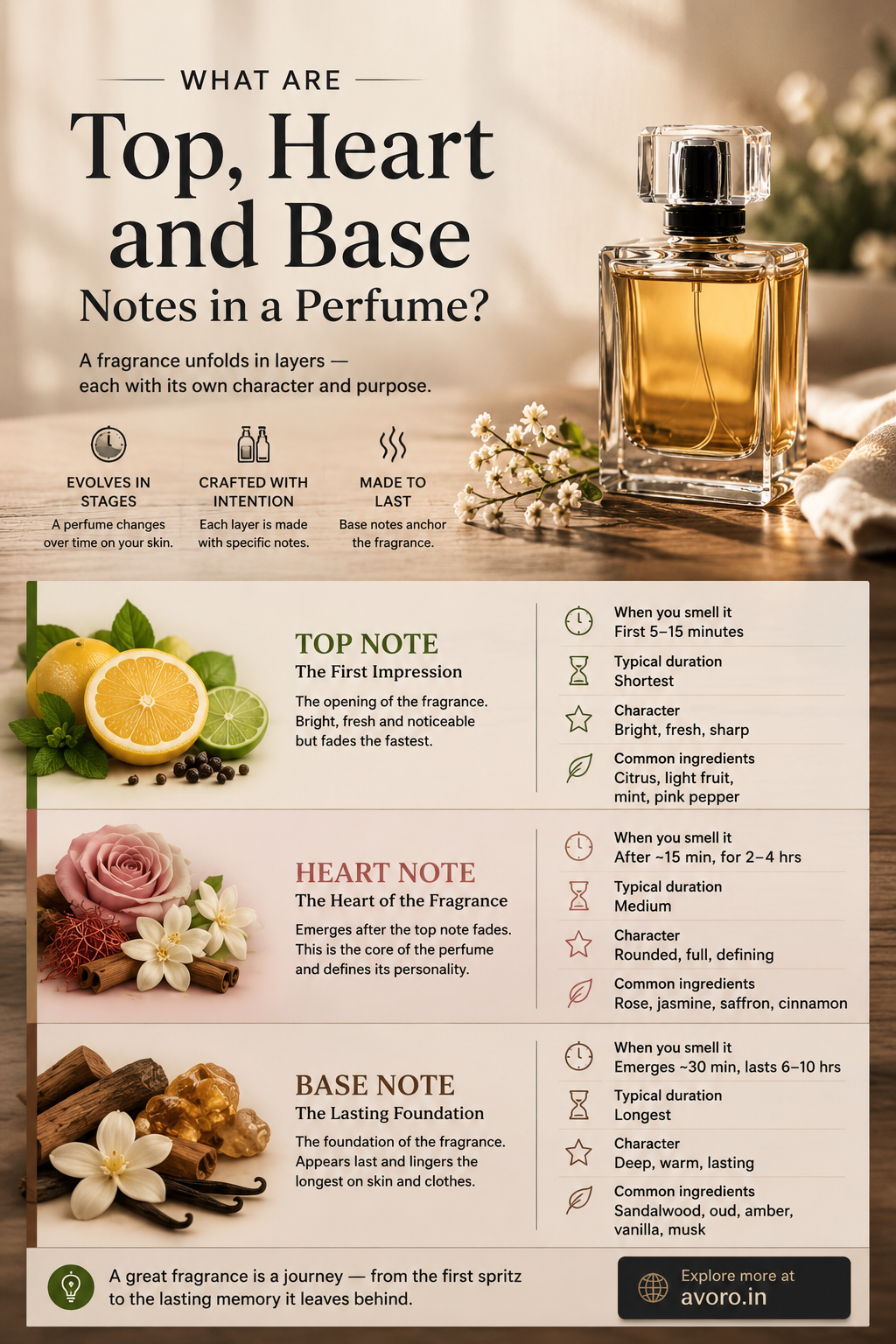
The perfume top note is the first impression the scent you smell in the initial few seconds to few minutes after spraying. Perfumers build the opening from the lightest, most volatile ingredients, which means they evaporate quickly and reach your nose first. That's why the top note is bright, sharp, and immediate, and also why it's the part that disappears fastest.
Think of the top as the handshake. It's designed to grab attention and pull you in, not to define the fragrance for the rest of the day. Common top note ingredients include:
Citrus: bergamot, lemon, orange, grapefruit, mandarin
Light fruits: apple, pear, berries, blackcurrant
Aromatic herbs: basil, mint, lavender, sage
Fresh spices: pink pepper, ginger, cardamom
Because these molecules are so light, a top note typically lasts only about 5 to 15 minutes before it starts fading into the layer beneath it. That short life is a feature, not a flaw it's the reason a fragrance feels like it "settles" as the morning goes on.
How Long Does a Perfume Top Note Last?
A top note usually lasts between 5 and 15 minutes, though very fresh citrus openings can vanish even faster in India's heat and humidity. This is the most important reason not to judge a fragrance by its first spritz alone. When you're testing, give it at least 20 to 30 minutes so the top burns off and the true character emerges. If you buy based only on the opening, you're buying the trailer, not the film.
What Are Heart Notes? The Heart of the Fragrance
Once the opening fades, the heart notes take over and this is where a fragrance shows its real personality. The heart note perfume layer, also called the "middle," forms the main body of the scent and typically lasts anywhere from two to four hours. If the top is the handshake, the heart is the actual conversation. The simplest way to understand heart notes perfume meaning is this: these are the notes the perfumer wants you to associate with the fragrance. They're rounder and mellower than the sharp opening, and they smooth the transition between the fleeting top and the deep base so nothing feels jarring.
Classic heart note ingredients include:
Florals: rose, jasmine, geranium, ylang-ylang, tuberose
Warm spices: cinnamon, nutmeg, clove, saffron
Fruity accords: peach, plum, passion fruit
Green and herbal tones: neroli, black tea
A well-built heart note perfume feels seamless you rarely notice the exact moment the top gives way, because the middle is already there to catch it. Saffron and a fruity heart, for instance, are what give a fragrance like AVORO's Oud Maracuja its distinctive warmth once the initial brightness lifts.
What Are Base Notes? The Foundation That Lasts
Base notes are the foundation of the fragrance of Avoro, the heaviest, slowest-evaporating ingredients that appear last and linger longest. They usually take about 30 minutes to fully emerge and can stay on skin (and clothing) for 6 to 10 hours, sometimes into the next day. These are the notes people mean when they say a perfume "smells expensive" or "has depth." Base notes do two jobs at once. They give the fragrance staying power, and they act as fixatives literally slowing down the evaporation of the lighter notes above them so the whole composition holds together longer. Typical base ingredients include:
Woods: sandalwood, cedar, oud (agarwood), vetiver
Resins and balsams: amber, benzoin, labdanum
Sweet and gourmand: vanilla, tonka bean, musk
Earthy tones: patchouli, oakmoss
Because bases are so persistent, they're what you smell on your scarf the next morning. In fragrances built around oud, amber, or vanilla, the base does most of the emotional heavy lifting.
The Fragrance Pyramid at a Glance
Perfumers visualise all of this as a "fragrance pyramid": top at the point, heart in the middle, base at the foundation. Here's how the three layers compare side by side.
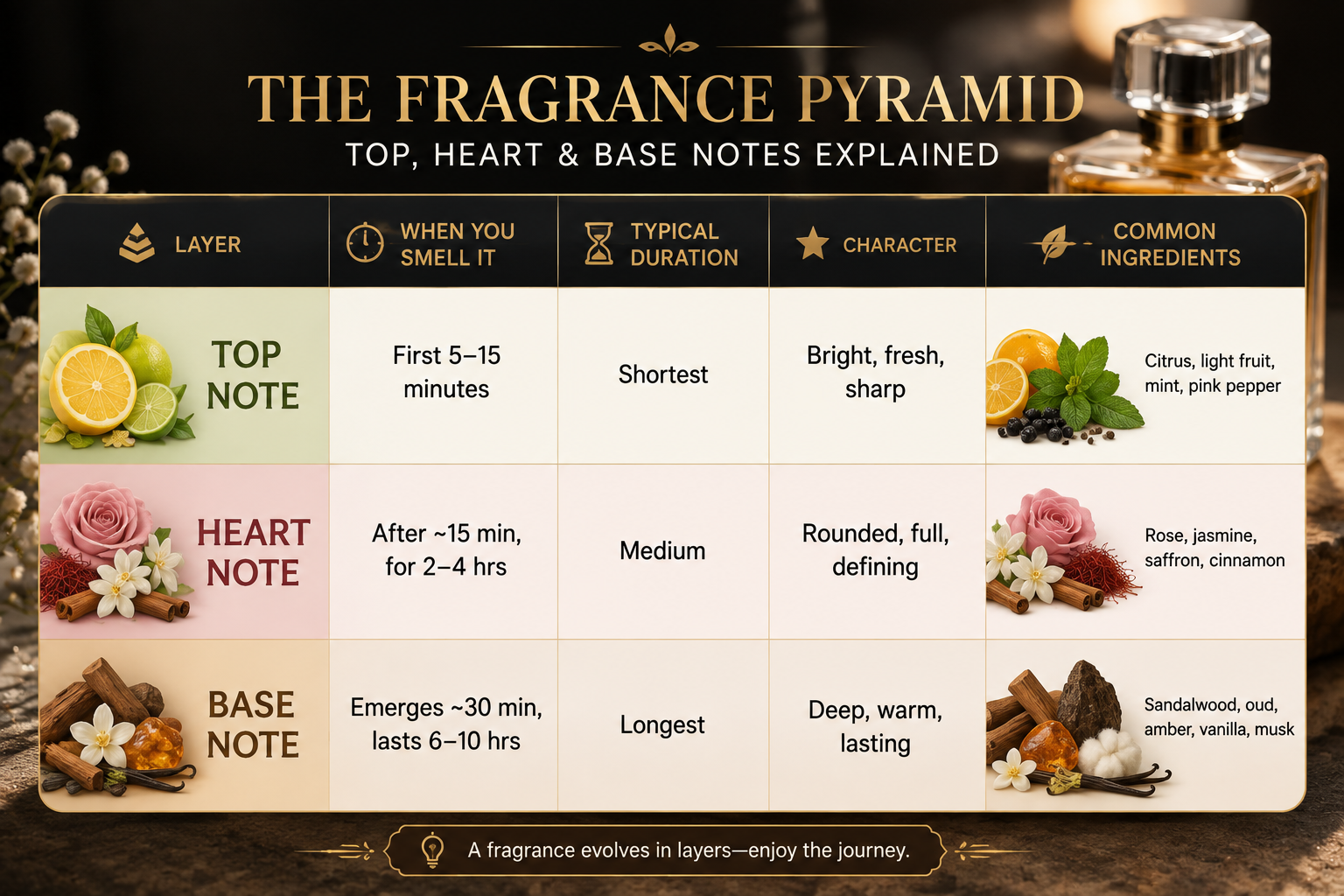
Read the pyramid from top to bottom and you're essentially reading a timeline of how the fragrance will behave on your skin across a day.
How Notes Interact With Concentration: EDP, EDT and Parfum
Two perfumes can share the same notes and still perform completely differently, and concentration is usually why. "Concentration" refers to the percentage of aromatic oils in the formula the higher it is, the richer and longer-lasting the scent, especially in the heart and base.
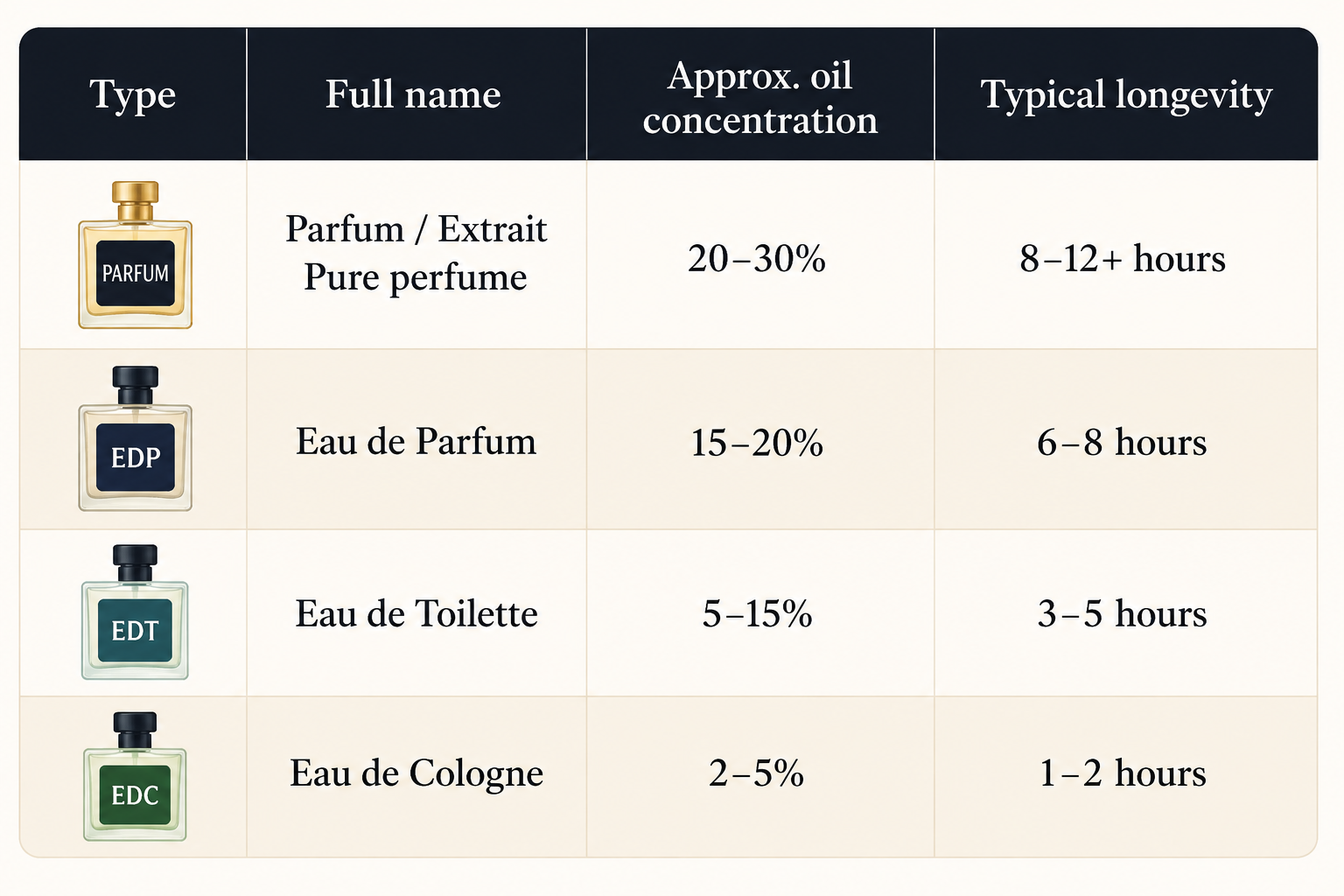
For the Indian climate, Eau de Parfum tends to be the sweet spot enough oil concentration to survive heat and long days, without the heaviness of a full extrait. All three of AVORO's launch fragrances are built as EDPs for exactly this reason: the higher oil load helps the heart and base hold their ground when the lighter top notes evaporate faster in warm weather.
Longevity, Projection and Sillage: The Words Worth Knowing
These three terms get thrown around a lot, and knowing them makes you a sharper shopper.
Longevity is how long the fragrance lasts on your skin, driven mostly by the base notes and concentration.
Projection is how far the scent radiates from your body, the "bubble" people notice when they lean in.
Sillage (pronounced see-yazh) is the scent trail you leave behind as you move through a room.
A fragrance can be long-lasting but sit close to the skin (low projection), or project loudly and then fade fast. There's no single best combination: a subtle skin scent for the office and a bold projector for an evening event are simply different tools for different moments.
Skin Chemistry: Why the Same Perfume Smells Different on You
Here's something most people never get told at the counter: the same perfume genuinely smells different from one person to the next. Your skin's pH, oiliness, diet, medication, and even hydration levels all interact with the fragrance oils and shift how the notes read. Drier skin tends to "eat" fragrance faster, shortening longevity, while oilier skin holds scent longer. This is exactly why a scent that smells incredible on a friend can fall flat on you and why testing on your own skin, not a paper blotter, is non-negotiable before buying.
Expert tip: apply a small amount of unscented moisturiser first. Hydrated skin holds fragrance molecules longer, giving you noticeably better longevity, especially with lighter formulas.
Practical Tips: Layering, Storage and Seasonal Choices
A little know-how goes a long way once you understand the note structure.
Layering. Applying a matching scented lotion or a lighter fragrance under your main one can extend longevity and add depth. As a rule, layer from heaviest to lightest, and keep the families related (a woody amber over a vanilla base works; a sharp citrus over a heavy oud usually clashes).
Storage. Heat, light and air are a fragrance's worst enemies they break down delicate top notes first. Keep bottles in a cool, dark place, away from bathroom humidity and direct sunlight. Stored well, a perfume can stay true for years; stored on a sunny windowsill, it can turn in months.
Seasonal choices. In hot, humid Indian summers, fresh citrus-aromatic and lighter fruity fragrances feel cleaner and don't turn cloying. For winter, weddings and festive evenings, richer oud, amber, saffron and vanilla compositions come into their own the cooler air lets those heavy base notes bloom beautifully.
Common Mistakes to Avoid
Even seasoned buyers slip up. Watch out for these:
Judging a fragrance by the top note alone. The opening fades in minutes. Always wait for the heart and base before deciding.
Testing too many scents at once. After three or four, your nose fatigues and everything blurs. Test two or three, then take a break.
Rubbing your wrists together. This crushes the molecules and can distort the top notes. Spray and let it dry naturally.
Shopping only online without sampling. Because of skin chemistry, a description can only take you so far. Use samples or decants when you can.
Storing bottles in the bathroom. The heat and humidity quietly degrade your fragrance over time.
Did You Know?
Oud is worth more than gold by weight. Genuine agarwood oil is one of the most expensive raw materials in all of perfumery, which is why authentic oud fragrances command a premium.
A perfumer is nicknamed a "nose." Master perfumers can distinguish and recall hundreds of individual raw materials from memory.
Vanilla in perfume is rarely just "sweet." As a base note it adds warmth, smoothness and that lingering "skin" quality that makes a scent feel intimate.
The fragrance pyramid is a guide, not a law. Modern "linear" perfumes are designed to smell almost the same from spray to dry-down, deliberately flattening the classic top-heart-base arc.
Frequently Asked Questions
1. What is a perfume top note in simple terms?
A perfume top note is the very first scent you smell after spraying, made from light, fast-evaporating ingredients like citrus and herbs. It creates the opening impression but fades within about 5 to 15 minutes as the heart notes take over.
2. What are top, heart and base notes in a perfume?
They're the three layers of a fragrance. Top notes are the brief opening, heart notes form the main body for a few hours, and base notes are the deep, long-lasting foundation. Together they create the "fragrance pyramid" that unfolds over a full day.
3. What is the heart notes perfume meaning?
The heart notes perfume meaning refers to the middle layer of a fragrance the notes that define its main character and last two to four hours. They emerge once the top fades and bridge the opening and the base, usually built from florals, spices or fruit.
4. How long does a perfume's top note last?
A top note generally lasts 5 to 15 minutes. Fresh citrus openings can fade even faster in hot, humid weather, which is why you should always wait 20 to 30 minutes before judging a scent.
5. Why does my perfume smell different after an hour?
Because it's meant to. The light top notes evaporate first, revealing the heart and then the base. What you smell after an hour is the true heart and base of the fragrance the part designed to last.
6. Which notes make a perfume last longer?
Base notes drive longevity. Heavier ingredients like sandalwood, oud, amber, musk and vanilla evaporate slowly and act as fixatives, holding the lighter notes in place. Higher concentrations such as EDP or parfum last longer than EDT.
7. What's the difference between EDP and EDT?
EDP (Eau de Parfum) has a higher oil concentration, roughly 15–20%, so it's richer and lasts 6–8 hours. EDT (Eau de Toilette) sits around 5–15%, feels lighter, and lasts about 3–5 hours. EDP is usually better for India's climate.
8. Should I judge a perfume by its first spray? No. The first spray is only the top note, which fades in minutes. Let the fragrance develop for at least half an hour on your own skin so you can smell the heart and base before deciding whether to buy it.
9. What does sillage mean?
Sillage is the scent trail a fragrance leaves behind as you move the impression others notice after you've passed. It's different from projection, which is how far the scent radiates while you're standing still.
10. Do perfumes really smell different on different people?
Yes. Skin pH, oiliness, hydration and diet all interact with fragrance oils, so the same perfume can smell warmer, sharper or fainter from person to person. That's why testing on your own skin matters more than any review.
Final Thoughts: Reading a Fragrance Like a Story
Once you understand that a perfume top note is just the opening line of a longer story, everything about buying fragrance gets easier. You stop falling for the first spritz, you start giving scents time to reveal their heart and base, and you learn to match a fragrance's structure to the moment, the season, and your own skin. That's the difference between guessing and choosing. The big takeaways: the top note grabs you but fades fast, the heart carries the fragrance's true character for hours, and the base is what lingers and lasts. Add in concentration, skin chemistry and smart storage, and you have everything you need to shop with confidence rather than luck. At AVORO, we think that kind of understanding shouldn't be a luxury reserved for collectors, it's simply what helps you enjoy fragrance more, whatever you choose to wear. Learn how the notes move, trust your own nose, and the right scent becomes far easier to find.